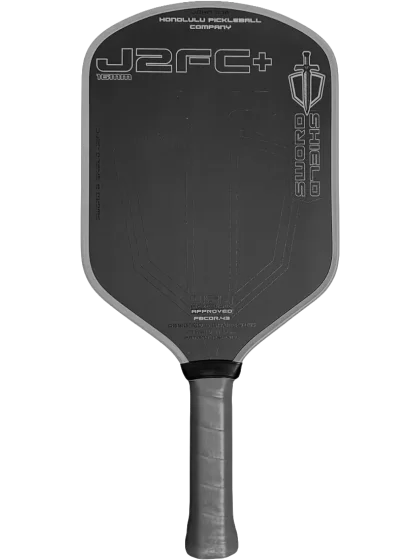
Honolulu J2FC+ 16mm Review: A Forgiving All-Court Paddle with Excellent Control
The Honolulu J2FC+ 16mm Hybrid is one of the more interesting foam-core paddles in the all-court category. Instead of focusing on maximum power, it offers a combination of control, forgiveness, stability, and maneuverability that I think will appeal to a wide range of players.
What interests me most about the J2FC+ is how it balances a relatively soft contact feel with enough responsiveness for aggressive play. It is designed to handle everything from baseline drives to delicate kitchen exchanges without feeling overly demanding.
At $195, it competes with several premium paddles. In this review, I'll break down its construction, performance characteristics, strengths, weaknesses, and how I think it compares with the Honolulu J2NF.
My Quick Verdict
I consider the J2FC+ a strong all-court option for players who value consistency over explosive power. Its forgiving sweet spot, manageable swing weight, and softer response make it especially appealing for doubles.
Best For: Intermediate to advanced players, control-oriented doubles players, and anyone looking for a forgiving paddle with enough offensive capability.
My Take: If I were choosing between maximum power and a more balanced paddle that makes defensive shots easier to manage, I would lean toward the J2FC+.
Pros and Cons
What I Like- Large and forgiving sweet spot for a hybrid shape.
- Soft, controlled response during drops, dinks, and resets.
- Low swing weight for quick hands at the kitchen.
- Good stability on off-center contact.
- Strong spin potential from the carbon-fiber surface.
- Balanced performance across offensive and defensive shots.
- Competitive value in the premium paddle category.
- Not designed for maximum explosive power.
- The softer feel may not appeal to players who prefer crisp feedback.
- Less reach than a traditional elongated paddle.
- Players seeking maximum put-away power may want something more aggressive.
Construction and Specifications
The J2FC+ uses a 16mm foam-core construction with a carbon-fiber hitting surface and a hybrid shape. The FC+ design incorporates a foam perimeter structure intended to improve the paddle's overall response.
I think the hybrid shape is an important part of its appeal. It offers a practical middle ground between the reach of elongated paddles and the forgiveness of wider designs.
The listed specifications include a static weight of 8.03 oz, swing weight of 108.3, twist weight of 6.85, and balance point of 235mm.
With a length of 16.2 inches and width of 7.8 inches, the J2FC+ offers a compact, maneuverable profile without sacrificing too much hitting surface.
One detail worth noting is the handle length. At 5.5 inches, it should work well for many players, although those who use a two-handed backhand may prefer a longer-handle alternative.
Power: Enough for All-Court Play, but Not a Power Monster
Power is not the main reason I would choose the J2FC+. Its listed power score of 67/100 places it in a more balanced performance category rather than among the most aggressive power paddles.
I see this as both a strength and a limitation. The J2FC+ should offer enough pace for serves, drives, and attacking opportunities, but players expecting effortless winners from short swings may find it less explosive than dedicated power paddles.
For my evaluation, the important distinction is usable power. A paddle that allows a player to swing confidently while maintaining directional control can be more valuable than one that simply produces the highest possible ball speed.
I would favor the J2FC+ for players who construct points through placement, spin, and consistency rather than relying entirely on overpowering opponents.
Pop: Responsive Without Feeling Overly Lively
The recorded pop measurement is 37.48 MPH. This helps describe the paddle's responsiveness during shorter, more compact strokes.
Pop matters most during counters, volleys, and fast exchanges at the kitchen line. A highly reactive paddle can make attacking easier, but it can also reduce the margin for error during defensive blocks.
I like the J2FC+'s positioning here. It offers a balance between responsiveness and control, rather than emphasizing an extremely lively face.
Compared with the J2NF, independent testing describes the J2FC+ as slightly softer and less reactive. I would view that difference as a preference rather than a clear advantage for either paddle.
Control and Touch: One of Its Biggest Strengths
Control is where I think the J2FC+ makes its strongest argument.
The softer contact response is particularly attractive for players who prioritize third-shot drops, defensive resets, and controlled dinking.
During these situations, too much rebound can make it difficult to keep the ball low. A more controlled paddle response can help players manage pace and placement.
I would especially consider the J2FC+ for players who struggle with resets popping up or soft shots traveling deeper than intended.
Of course, paddle construction cannot replace technique. But I think the J2FC+'s combination of touch and forgiveness gives it a useful advantage for players who want more consistency in the transition zone and at the kitchen.
Spin: Plenty of Potential for Modern Play
The J2FC+ has a listed spin score of 80/100. I consider that a promising indicator of its spin-oriented capabilities.
Spin has become an essential part of modern pickleball. Whether you're hitting topspin drives, dipping attacks, or controlled slice returns, the ability to shape the ball's trajectory can make a significant difference.
The carbon-fiber surface provides the type of textured contact that players commonly look for in spin-focused paddles.
I wouldn't describe spin as the J2FC+'s only defining feature, but I see it as another important part of its all-court versatility.
Forgiveness: A Standout Characteristic
Forgiveness is probably the biggest reason I would put the J2FC+ on a player's shortlist.
One of the most encouraging findings from independent reviews of Honolulu's foam-core lineup is the unusually large sweet spot for a hybrid-shaped paddle.
A forgiving sweet spot is valuable because players rarely make perfect contact on every shot, especially during fast exchanges or difficult defensive situations.
The listed twist weight of 6.85 also suggests useful resistance to twisting when the ball contacts the paddle away from the center.
I place considerable value on this characteristic. A paddle that maintains a predictable response on imperfect contact can help players stay competitive during difficult rallies.
For intermediate players in particular, I think forgiveness can be more beneficial than a small increase in maximum power.
Maneuverability: Quick Hands at the Kitchen
With a swing weight of 108.3, the J2FC+ falls into a maneuverable range that I find attractive for doubles play.
Lower swing weight generally makes it easier to accelerate and reposition the paddle during fast exchanges.
This matters when blocking body attacks, reacting to speedups, or switching quickly between forehand and backhand counters.
I also like how the hybrid shape complements this characteristic. Rather than maximizing reach at the expense of handling, the J2FC+ offers a more balanced profile.
Players who value fast preparation and compact strokes should find these specifications particularly appealing.
J2FC+ vs. J2NF: Which One Would I Choose?
Honolulu's naming system can be confusing, especially when comparing the J2FC+ with the J2NF.
Both use modern foam-core construction, but their designs and face layups differ. The J2NF uses a notched foam design, while the J2FC+ uses a more conventional foam perimeter structure.
Independent testing suggests that the J2NF feels slightly firmer and more reactive during fast exchanges. The J2FC+ has a somewhat softer response, particularly during resets and touch shots.
I wouldn't exaggerate the difference. The two paddles share many characteristics, including good stability, forgiveness, and all-court versatility.
My preference would depend on playing style:
- J2FC+: My choice for a softer feel, controlled resets, and touch-oriented doubles play.
- J2NF: My choice for players who prefer a firmer response and slightly more reactive counters.
If control is the priority, I would lean toward the J2FC+. If quick counterattacks and crisp feedback matter more, I would give the J2NF serious consideration.
Should You Add Weight?
One of the advantages of the J2FC+ is that its relatively low swing weight leaves room for customization.
I would start by evaluating the paddle in its stock configuration before adding any weight.
If additional plow-through is needed, a small amount of weight near the upper sides of the paddle may help increase hitting mass and stability.
However, added weight also increases swing weight and can reduce hand speed. For that reason, I would avoid making large changes without a specific goal.
Since maneuverability is one of the J2FC+'s advantages, I wouldn't want to sacrifice too much of it.
Who Should Buy the J2FC+?
I would recommend considering the J2FC+ for intermediate and advanced players who want a dependable all-court paddle.
It makes particular sense for doubles players who spend a lot of time at the kitchen and need a combination of quick handling, touch, and stability.
I also think it is worth considering for players moving away from overly powerful paddles that make drops and resets difficult to control.
On the other hand, I would look elsewhere if maximum put-away power, an elongated hitting surface, or an especially stiff and explosive feel were my top priorities.
Value: Is It Worth $195?
At a listed price of $195, the J2FC+ sits below some of the most expensive premium paddles on the market.
I think its value comes from offering a balanced package rather than one exceptional performance number.
Players get a forgiving hybrid shape, manageable swing weight, good stability, strong spin potential, and a controlled contact feel.
For someone looking for a single paddle that can handle a variety of situations, I consider that combination appealing.
My Final Verdict
I see the Honolulu J2FC+ 16mm Hybrid as a well-rounded paddle that prioritizes consistency, forgiveness, and control without giving up too much offensive capability.
Its biggest strengths are the generous sweet spot, stable response, manageable swing weight, and softer touch. Those are exactly the characteristics I would look for in a dependable all-court doubles paddle.
I wouldn't choose it purely for maximum power. There are more aggressive options available for players who want the hardest possible drives and counters.
But I believe the J2FC+ offers something that may be more valuable to many players: a balanced combination of performance characteristics that makes a wide variety of shots easier to manage.
My Verdict: The Honolulu J2FC+ is a strong all-court option for players who value touch, forgiveness, stability, and fast handling. I would put it on my shortlist for control-oriented doubles players who want premium foam-core performance without chasing maximum power.